Crane Creek and the working waterfront
Boat-building, citrus shipping, mullet fishing, and the seventy-year stretch when Melbourne's tidal creek was a paying industrial address.
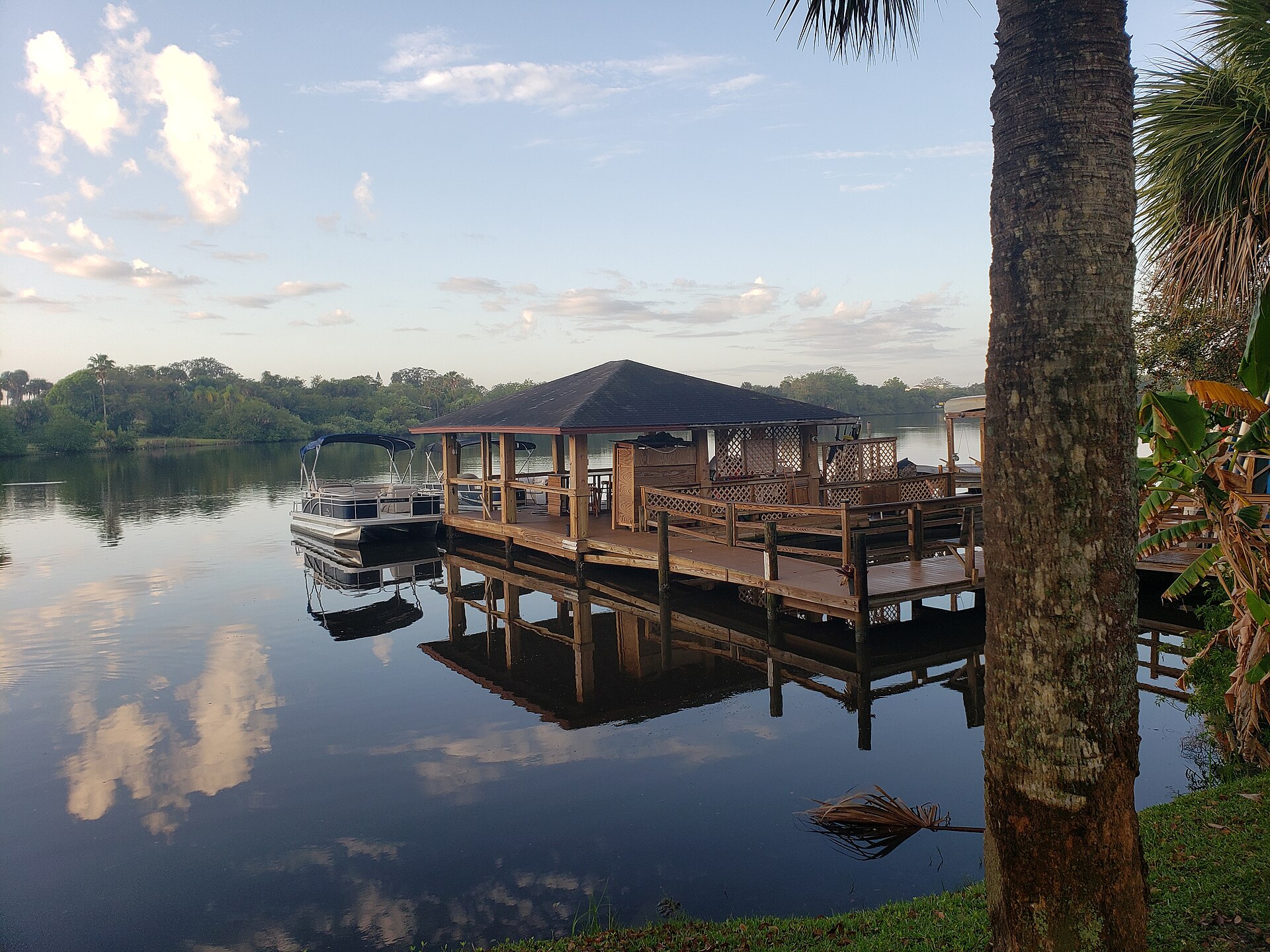
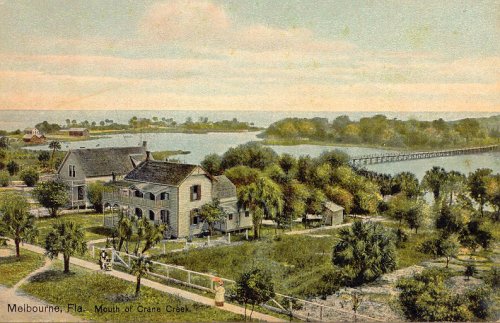
Crane Creek runs about a mile and a quarter from its headwaters near Hickory Street to its mouth at the Indian River Lagoon. For roughly seventy years, from the 1880s through the early 1950s, that mile and a quarter was Melbourne’s industrial address. Boat-builders worked the south bank. Citrus packing houses lined the north. The fishing fleet tied up wherever there was a piling. By the time of the Eau Gallie merger in 1969 most of it was gone, replaced by a public boat ramp, a few restaurants, and a marina. But for three generations Crane Creek was where Melbourne earned its money.
Why a tidal creek mattered
Before US-1 was paved in the 1920s and before the FEC arrived in 1893, every load that came in or out of Melbourne moved on water. The Indian River Lagoon was the highway. A barge or a sailing freighter would tie up offshore. Smaller boats, drawing four feet or less, ran the cargo to the working docks on Crane Creek. The creek’s mouth had enough depth (six to eight feet at low tide in the 1880s, per FEC surveys for the 1893 right-of-way) to handle the boats Brevard’s economy actually used.
The other thing Crane Creek had was a shoreline you could build on. The Indian River front was exposed; a stiff northeaster could tear a dock apart. The creek was sheltered. A small dock built in the 1880s on the creek would still be standing in 1920. A dock on the open river would be rebuilt every six years.
The fishing fleet
The Crane Creek fleet was always small. Twenty to forty boats at peak. They worked mullet and trout in the lagoon, redfish on the flats, and offshore for kingfish and snapper. The fish house at the creek mouth, operating under three different owners between 1895 and 1958, bought the day’s catch, iced it down, and shipped to Jacksonville and Tampa wholesalers by FEC.
The fishing economy never made anyone rich but it kept a lot of families fed through bad citrus years. The 1894-1895 great freeze, which wiped out Brevard’s citrus for half a decade, was survived in Melbourne in part because the lagoon’s fish kept producing. The 1962 freeze repeated the lesson on a smaller scale.
Commercial fishing on the lagoon collapsed in the 1990s and 2000s due to a combination of regulatory net bans (Florida’s gill-net ban took effect 1995), declining lagoon water quality, and seagrass loss. By 2010 there were essentially no full-time commercial mullet boats operating out of Melbourne. A few sport-fishing charter operations replaced them.
The 1894-1895 freeze and the fishing safety net
The decade that defined the working creek’s resilience was the 1890s, and the test was the Great Freeze. Two consecutive cold events struck the Florida citrus belt in the winter of 1894-1895: a December 1894 freeze that drove Orlando to an all-time record low of 18 °F on December 28, 1894, followed by a second freeze in early February 1895 with West Palm Beach hitting 27 °F on February 9. Statewide citrus output collapsed from roughly six million boxes the prior season to about 100,000 boxes the following year, and Florida did not return to a million-box harvest until 1901. Land values in citrus districts fell from around $1,000 per acre to as low as $10.
Melbourne’s mainland economy in 1894 was citrus-first. The freeze should have wrecked it. What kept families on the creek was the lagoon. The mullet, trout, and redfish were unaffected by air temperature. The fishing fleet kept working through the winter of 1894-1895 and through the rebuilding years that followed, and the daily catch shipped on the FEC turned into the cash that paid mortgages while the groves were replanted. The 1962 freeze, smaller in scope but more concentrated on Brevard, replayed the same pattern at smaller scale. The diversified mainland-and-water economy of Crane Creek was structural insurance against any single agricultural collapse.
The 1995 net ban and the end of commercial mullet
The commercial fleet on Crane Creek outlasted the citrus collapses but did not outlast a single ballot measure. In November 1994, Florida voters approved a state constitutional amendment, marketed as “Save Our Sealife,” banning the use of entanglement nets (including gill nets) in state coastal waters. The amendment took effect July 1, 1995. Cast nets remained legal, but the practical commercial-volume gear for mullet, the principal Brevard species, was the gill net.
The effect on the Indian River Lagoon fleet was immediate and absolute. Mullet boats that had run continuous family operations on Crane Creek for four generations could not switch gear and remain commercially viable. Some operators converted to charter and sport fishing; most retired. By the early 2000s the working commercial mullet fishery on the lagoon was effectively gone. Florida Fish and Wildlife Commission stock assessments from the 2000s and 2010s show mullet populations rebounding under the net ban, which was the amendment’s intended effect. The cost was the small-boat fleet itself, which had been part of the creek’s economic identity since the 1880s.
The lagoon’s broader collapse over the same period, seagrass die-off, harmful algal blooms, and the prolonged 2011-2016 Indian River Lagoon ecosystem crisis, would likely have ended commercial fishing on its own within a decade or two. The net ban just compressed the timeline.
The transition: 1955 to 1975
The waterfront’s industrial era ended in slow motion. The 1962 freeze killed the citrus association. The Marsh yard closed in 1958 when the last family operator retired without a successor. The fish house at the creek mouth closed in 1973. The land was rezoned commercial-recreational in 1971. The current marina opened in 1976.
The Eau Gallie merger in 1969 sped up the transition. The combined city had less appetite for the old packing-house aesthetic and more for tourist-friendly waterfront. The Civic Center, opened 1975, sits on what had been packing-house ground for seventy years.
What’s there now
A public boat ramp. The Crane Creek Promenade, a brick-paved riverwalk that runs from the FEC tracks east to the lagoon. A few restaurants. The Civic Center. A marina with about 90 slips, mostly recreational. One historical marker. One small interpretive sign at the promenade’s east end.
The creek itself is shallower than it was in 1900. Decades of upstream development and silt have raised the bottom by an estimated three feet. The mouth still goes to six feet at low tide but the upper reaches that once floated working boats are now too shallow for anything bigger than a kayak.
What’s lost: the smell of citrus oil. The sound of caulking mallets. The mullet boats coming in at dawn. The packing-house whistles that signaled shift change. None of it is in any museum. The creek looks pretty now, in a way it never did when it was working.
Sources
- Florida Memory Project, State Archives of Florida, Brevard County waterfront photographs and oral history collection, accessed 2026-01-06. https://www.floridamemory.com/
- City of Melbourne, “Our History,” accessed 2026-01-06. https://www.melbourneflorida.org/about-us/about-melbourne/our-history
- US National Register of Historic Places nomination, “Old Melbourne Historic District,” NRIS 87000926, 1987.
- Florida Fish and Wildlife Conservation Commission, “Florida Net Ban” history page, accessed 2026-01-06. https://myfwc.com/fishing/saltwater/regulations/
- Florida East Coast Railway 1893 right-of-way survey, Brevard County section. State Library and Archives of Florida.
- US Navy Bureau of Ships records, subchaser construction contracts 1942-1943. Naval History and Heritage Command.
- “Great Freeze,” Wikipedia, on the December 1894 and February 1895 cold events, the Orlando 18 °F low of December 28, 1894, and the collapse of Florida citrus output from approximately six million boxes to roughly 100,000. https://en.wikipedia.org/wiki/Great_Freeze
- Florida Constitution, Article X, Section 16 (the 1994 “Save Our Sealife” amendment limiting marine net fishing, effective July 1, 1995). Florida Department of State, Division of Elections.
Further Reading
As an Amazon Associate we earn from qualifying purchases.