The Henegar Center: a 1919 high school that became Melbourne's stage
Melbourne High School opened in 1919 as a yellow-brick neoclassical statement. Eighty years later it was abandoned, condemned, and almost lost. Here's the building, the rescue, and the second life as a 580-seat performing arts hall.
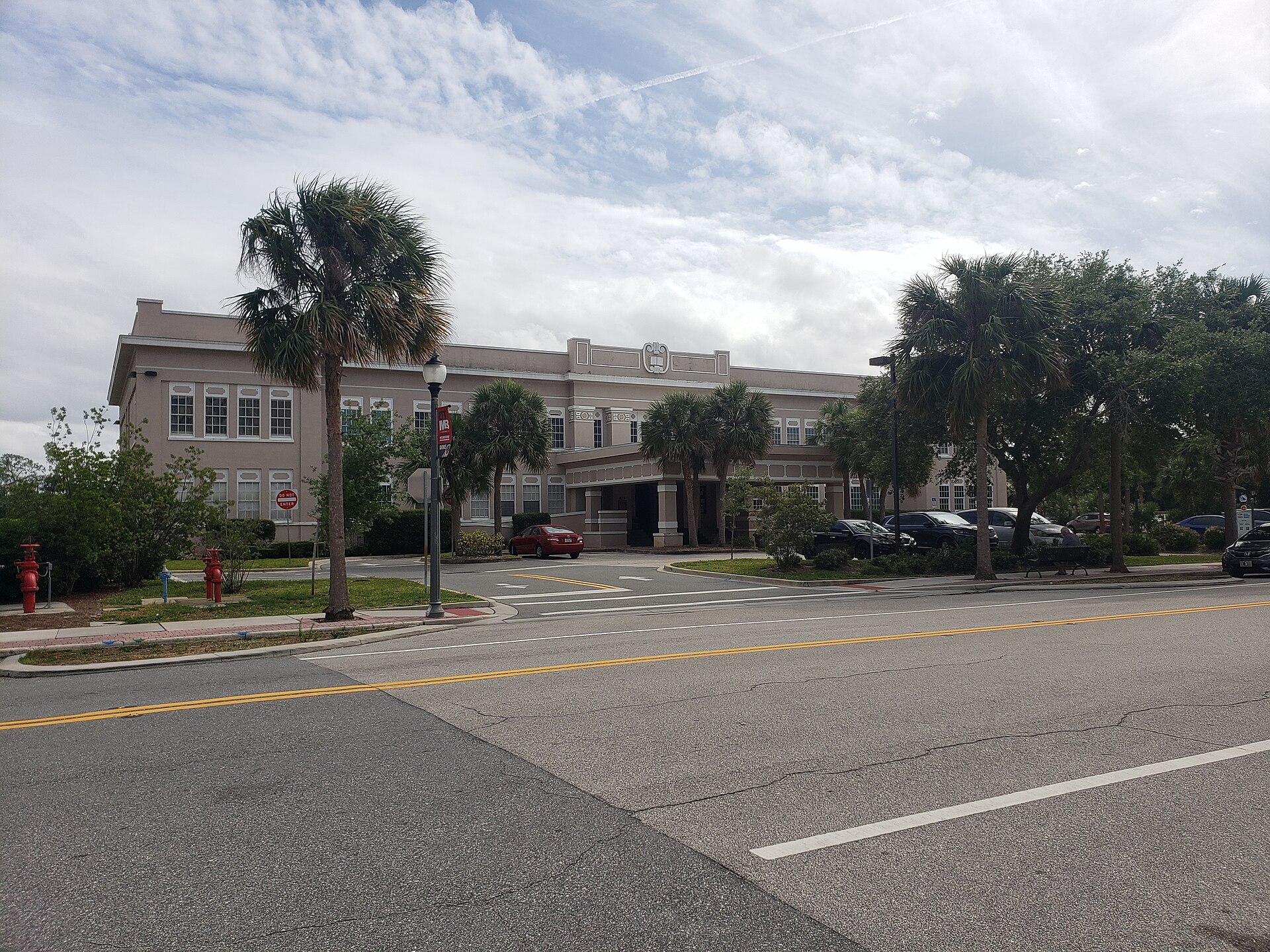
The Henegar Center for the Arts is a yellow-brick neoclassical building at 625 East New Haven Avenue. It opened in 1919 as Melbourne High School, served as the city’s secondary school for forty-two years, was abandoned in the 1960s, condemned in the 1980s, and rescued by a community campaign in the early 1990s. Today it runs a 580-seat main theater, a 110-seat black-box space, and a year-round program of musicals, concerts, dance, and children’s productions. It is the most visible piece of Melbourne’s pre-merger civic legacy still functioning as a public asset.
The short version: it almost got knocked down. Twice.
The 1919 building
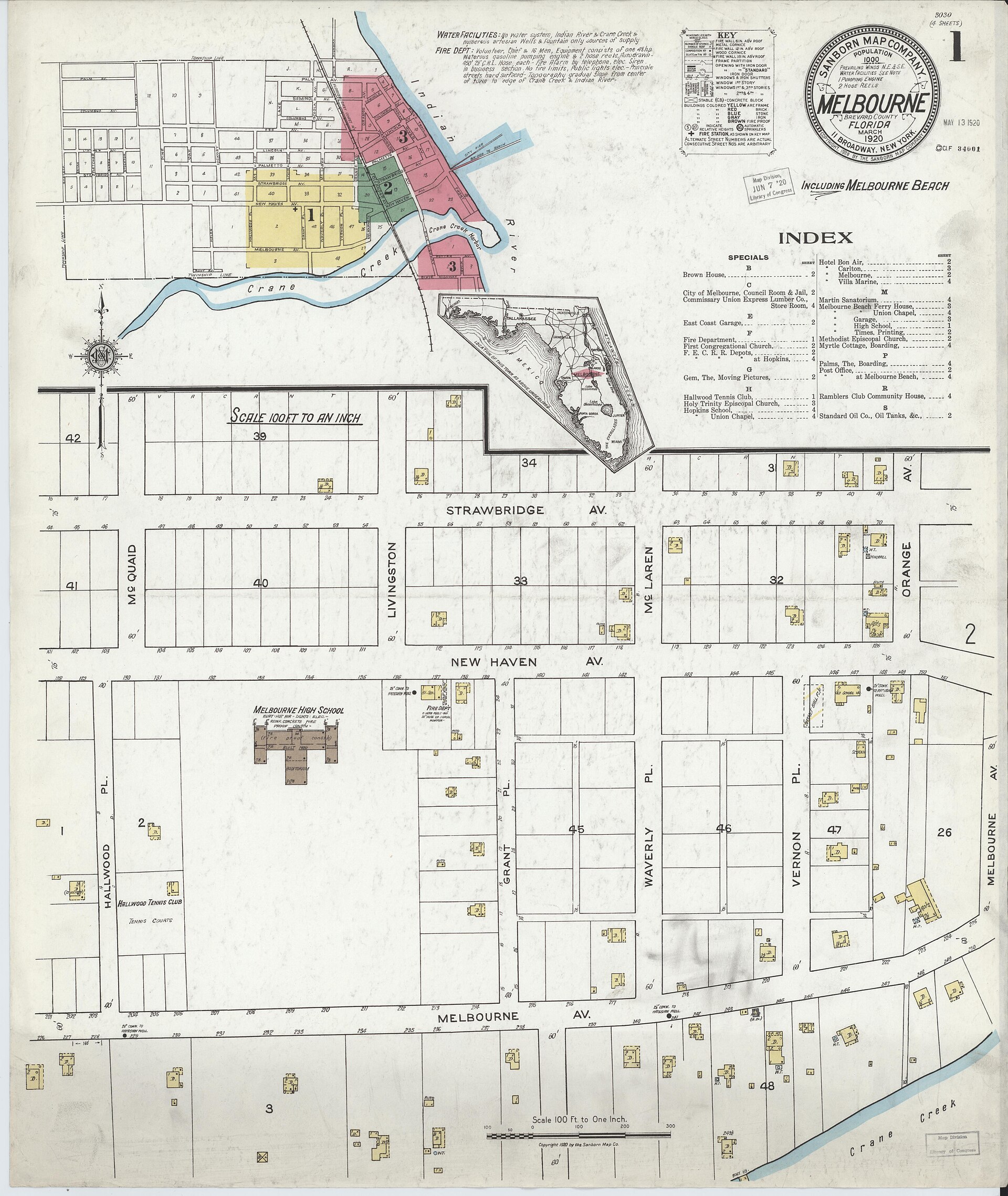
Melbourne’s original high school dated to 1898, a one-room frame structure that quickly proved inadequate. By 1916 the city was floating a bond issue for a real high school. The bond passed. The school board hired Wm. C. Long, a Jacksonville architect, to design a building in the neoclassical revival style fashionable for Florida school construction in the 1910s. Construction began in 1917, delayed by wartime material shortages, and completed in fall 1919.
The building cost about $75,000 in 1919 dollars (roughly $1.3 million in 2026 dollars). Two stories plus a basement. Yellow brick on a poured-concrete foundation, with white Doric columns at the south entrance. The main auditorium seated 500 on a sloped wood floor with a balcony on three sides. Twelve classrooms, a library, a science laboratory, and a principal’s office. The Melbourne High Bulldogs played basketball in a separate gymnasium added in 1928.
The school’s first graduating class was four students. By the 1940s the class size had grown to roughly fifty. By 1958 the school was overcrowded and the school board began planning a replacement.
The 1960s and 1970s
Melbourne High School moved to a new campus on Wickham Road in 1961, taking the Bulldogs name with it. The 1919 building was repurposed as an elementary school (1961-1968), then as a Brevard County administrative office (1968-1972), then mostly abandoned. The Henegar Foundation, named for a longtime principal, briefly used the building for community programming in the late 1970s. By 1985 it was condemned for structural and code violations. The roof leaked. The HVAC was beyond economic repair. The wiring was 1919 knob-and-tube. The Brevard County Commission seriously considered demolition in 1986 and again in 1989.
What saved the building was timing. The Old Melbourne Historic District was placed on the National Register in 1987. Demolition of a contributing structure in a registered district triggers federal Section 106 review and forfeits any associated tax credits. The 1989 demolition proposal died in part because the alternative was a clean tax-credited rehab.
A community fundraising drive launched in 1990. Local donors, the City of Melbourne, Brevard County, and a state historic preservation grant collectively raised about $4.5 million by 1994. The building was gutted to the masonry shell, the roof was rebuilt, all systems were replaced, and a new fly tower was added for stage rigging. The Henegar Center for the Arts opened in November 1995.
What’s there now
The main theater is a working professional venue. Its season runs roughly September through June, with a summer youth program. Recent and recurring productions have included full-scale musicals (Les Misérables, Phantom, Newsies), national tours making smaller stops, the Melbourne Civic Theatre’s resident-company shows, and the Henegar’s own youth-theatre training program.
The 110-seat black-box space (the Lacy McLarty Studio Theatre) handles smaller productions, classes, and community rentals. The Henegar runs a regional drama academy out of a separate education wing. Annual attendance across all productions runs roughly 60,000 to 80,000.
The center is a registered 501(c)(3) nonprofit. About 65% of revenue comes from ticket sales, 20% from donor giving, 10% from rental of the spaces by community organizations, and 5% from grants. It’s a sustainable model for a venue of its size in a market the size of Brevard.
The name
The building is named for Robert M. Henegar, principal of Melbourne High School from 1925 to 1957. Henegar was a Tennessee-born educator who built the school’s identity through the Depression and World War II and is regarded locally as the figure who made Melbourne High a functioning small-town comprehensive school instead of a glorified eighth-grade extension. He died in 1965. The naming of the foundation and later the rehabilitated building after him was a 1970s decision by his former students, several of whom were by then on the Melbourne city council.
Why this matters in a Melbourne history
Three reasons.
First, the Henegar is the only major piece of Melbourne’s pre-1969 institutional infrastructure that’s still in public use and still recognizable. Most of what was built before the merger has either been demolished (the 1898 first school, the Marsh boatyard, both citrus packing houses, the original FEC depot) or radically remodeled. The Henegar is the rare survivor with its facade and footprint largely intact.
Second, the rescue is a useful counterexample to a Florida pattern of letting historic buildings fall. From the 1950s through the 1990s most of small-town Florida lost its early-twentieth-century stock to tear-down redevelopment. Melbourne managed to save the Henegar partly through dumb luck (the NRHP listing arriving before the demolition vote) and partly through a sustained local campaign. Similar buildings in similar Brevard towns didn’t get saved.
Third, the building is doing work. It’s not a museum. It’s a working theater that produces 200-plus performances a year. That’s a better outcome than the alternative of a frozen-in-time exhibit nobody visits.
What’s lost
The original 1919 auditorium had a wood-floored slope with carved oak details on the proscenium. Most of that was destroyed by water damage during the abandoned years. The 1995 restoration recreated the proscenium in MDF and paint and rebuilt the slope in steel. The acoustic profile of the modern auditorium is better than the original was (the 1919 plaster was already failing by the 1950s), but it’s a 1990s reconstruction, not a preserved interior.
The original library room on the second floor is now the executive offices. The original science classroom is a rehearsal hall. The original cafeteria is the lobby. The building’s history is preserved as a shell, not a working interior.
A small interpretive display on the ground floor near the box office tells the building’s history. The Henegar Foundation occasionally runs guided architectural tours. It’s worth one if you’re in Melbourne and have an hour.
Sources
- Henegar Center for the Arts, institutional history and programming, accessed 2026-01-09. https://www.henegar.org/
- US National Register of Historic Places nomination, “Old Melbourne Historic District,” NRIS 87000926, 1987.
- City of Melbourne, council minutes and historic preservation records, 1985-1995.
- Brevard County School Board, historical records of the Melbourne High School campus, accessed 2026-01-09.
- Florida Division of Historical Resources, state historic preservation grants 1990-1994.
- Florida Historical Society, “Brevard County Schools” archival collection, accessed 2026-01-09. https://myfloridahistory.org/
Further Reading
As an Amazon Associate we earn from qualifying purchases.