L3Harris Technologies and Melbourne's defense-electronics industry
From Radiation Inc. in 1950 through Harris Corp. through the 2019 L3 merger, Melbourne has been the headquarters of one of America's mid-sized defense contractors for seven decades. Here's the corporate history and the city's stake in it.
L3Harris Technologies is the third corporate identity of the Melbourne defense-electronics business that began as Radiation Incorporated in 1950, became Harris Corporation through a 1967 acquisition, and reached its current name through the 2019 merger of Harris with L3 Technologies. The company is Melbourne’s largest single private employer (approximately 12,000 employees in Brevard County as of 2024), the dominant tax base contributor in the city, and the most consequential single corporate entity in Brevard County’s modern history.
This article walks the corporate evolution and what it has meant for the city.
Radiation Inc., 1950 to 1967
The company was founded in 1950 as Radiation Incorporated by George E. Shaw, a former government engineer who had identified an opportunity to provide telemetry and measurement systems for the Air Force’s missile testing programs at Cape Canaveral. The company was tiny initially: a few engineers, a small leased facility in Melbourne, total revenues under $1 million.
The Cape’s growth drove the company’s growth. Through the 1950s and into the 1960s, Radiation Inc. built telemetry receiving systems, antenna systems, data-acquisition hardware, and ancillary electronics for the missile testing and later the manned space program. The company was strategically positioned: physically close to the customer (the Cape), technically aligned with the customer’s needs (specialized aerospace electronics), and culturally compatible with the federal government’s procurement processes.
By the mid-1960s Radiation Inc. had grown to approximately 4,000 employees and revenues approaching $100 million annually. The company was, by Brevard County standards, a major industrial operation. It was the largest private employer in the county by 1965.
The 1967 acquisition by Harris-Intertype
In 1967, Harris-Intertype Corporation (an Ohio-based printing-equipment manufacturer) acquired Radiation Inc. The combined company was named Harris Corporation. The acquisition was significant in two ways:
1. Capital and scale. Harris-Intertype provided much larger capitalization than Radiation Inc. had access to. Subsequent investment in expansion, R&D, and new product lines depended on Harris’s deeper resources.
2. Headquarters location. Initially Harris was headquartered in Cleveland with the Radiation operations a Melbourne subsidiary. Through the 1970s and 1980s the company’s center of gravity shifted to Florida as the defense and electronics businesses grew faster than the legacy printing business. In 1980 Harris formally moved corporate headquarters to Melbourne. The relocation was a major Brevard County event: Cleveland was a much larger city than Melbourne, but the company chose Melbourne because that’s where the strategic business was located.
The Harris Corp years, 1967 to 2019
Through the 1970s, 1980s, 1990s, and 2000s, Harris Corp. grew into a major mid-tier US defense and communications contractor. Its product lines included:
- Defense electronics: tactical radios, antenna systems, electronic warfare gear.
- Government communications: encrypted radio systems for federal customers, including the heavily classified intelligence community accounts.
- Broadcasting equipment: television and radio broadcasting transmitters, antennas, and studio gear (a legacy of the Harris-Intertype origins).
- Civil aviation systems: air traffic control infrastructure, including the FAA’s controller workstation systems.
- Space systems: satellite components, ground systems, optical and antenna systems for spacecraft.
The company’s revenues grew from about $400 million in 1980 to approximately $7 billion at the time of the 2019 merger. Employment in Brevard County remained the largest single concentration, fluctuating between roughly 6,000 and 9,000 over the decades.
The Brevard County campus expanded substantially. The main complex on Palm Bay Road grew through multiple expansion phases. Additional facilities in Palm Bay and along the West Eau Gallie Boulevard corridor housed specialized engineering teams. By the 2010s the Harris footprint in south Brevard was extensive.
The 2019 L3 merger
In June 2019, Harris Corporation merged with L3 Technologies (a New York-based defense electronics company with about $11 billion in annual revenue) to form L3Harris Technologies. The combined company had approximately $18 billion in annual revenue, 50,000 employees worldwide, and ranked as the sixth-largest US defense contractor by revenue.
The merger was structured as a merger of equals on the financial terms but Harris was the surviving corporate identity. The headquarters remained in Melbourne. The Harris CEO at the time, William Brown, became the merged company’s CEO; the L3 CEO, Christopher Kubasik, became the chairman and later CEO.
For Melbourne, the merger consolidated and extended what Harris had already meant to the city: a major corporate headquarters, substantial local employment, significant local tax contribution, philanthropic anchor, and the proof point that a national-scale defense contractor could be based in south Brevard.
Current operations
As of 2026 L3Harris Technologies operates from corporate headquarters in Melbourne with approximately 12,000 employees in Brevard County. The Brevard campus includes the executive offices, major engineering centers, manufacturing facilities for several product lines, and specialized test and integration facilities. Specific local product lines include:
- Tactical communications equipment for US and allied military customers.
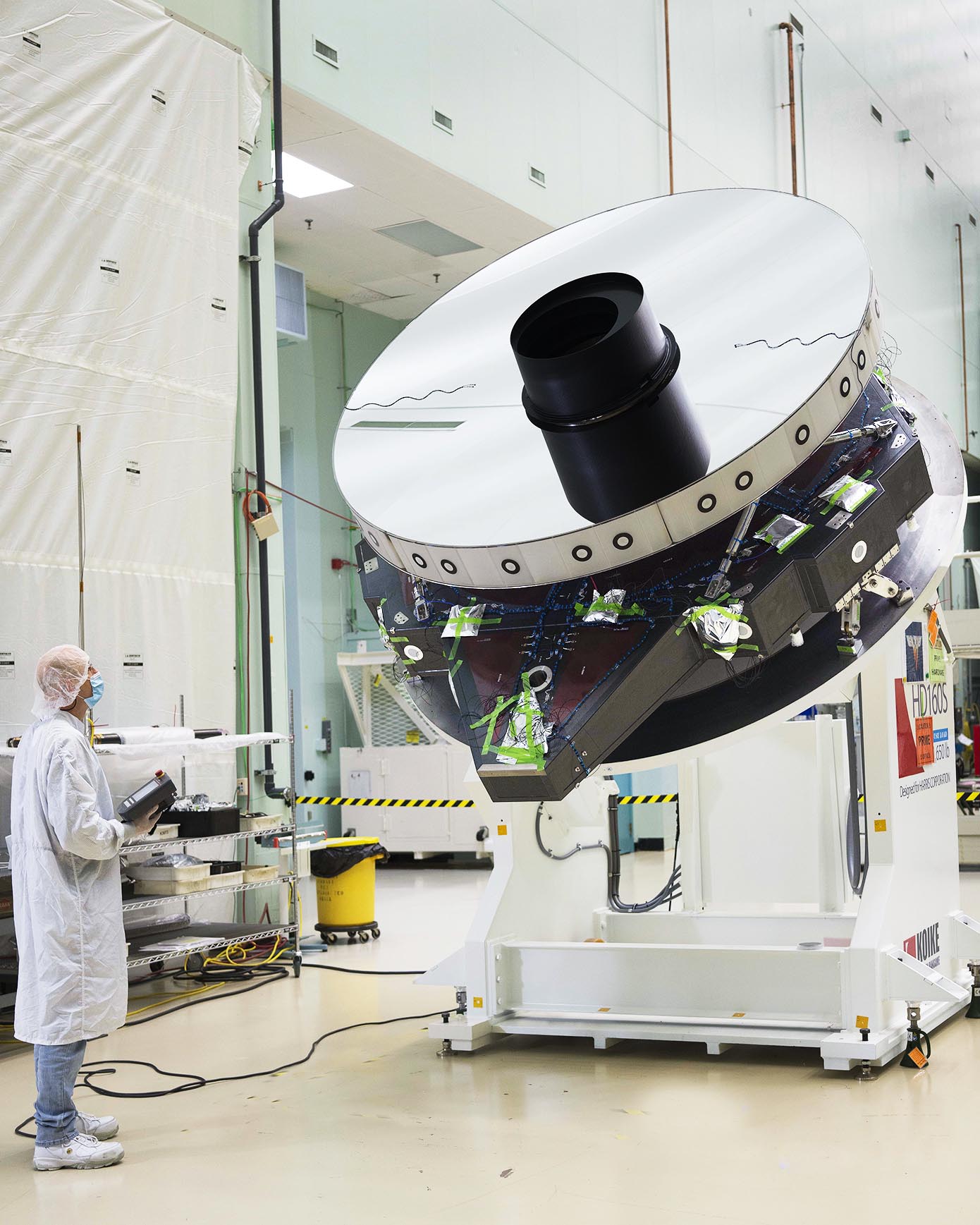
- Space systems components, including the optical mirror work for NASA’s Roman Space Telescope referenced in the hero image.
- Air traffic control systems for FAA and international civil aviation customers.
- Maritime systems, including underwater electronics and antenna systems for naval and intelligence customers.
- Electronic warfare and avionics for combat aircraft programs.
Annual L3Harris Brevard County payroll exceeds $1.5 billion. The company’s local procurement (suppliers, contractors, services) adds another $500 million to $1 billion of regional economic activity annually. Total Brevard County economic dependence on L3Harris, including direct, indirect, and induced effects, is in the range of $5 to $7 billion of annual economic activity.
What L3Harris means for Melbourne
Six measurable effects.
1. Workforce concentration. L3Harris is the single biggest reason south Brevard has a substantial engineering professional workforce. Other employers benefit from the existence of that workforce.
2. Tax base. Property taxes on L3Harris facilities and personal property taxes on equipment contribute substantially to City of Melbourne and Brevard County revenues. Estimates vary but L3Harris is consistently in the top three local taxpayers.
3. Philanthropic anchor. Harris Corp. and now L3Harris are major donors to FIT, the BSO, the Henegar Center, and other regional cultural institutions. Several institutional facilities (the Harris Center for Science and Engineering at FIT, opened 2014) carry the Harris name directly.
4. Workforce pipeline relationship with FIT. Decades of close cooperation. FIT engineers staff L3Harris jobs. L3Harris engineers teach FIT classes. Collaborative research programs in optics, electronics, and space systems run continuously.
5. Real estate market. Engineering professional salaries support the housing market in middle and upper-middle south Brevard neighborhoods. The Suntree-Viera-Indialantic corridors have substantial L3Harris-employee resident populations.
6. Civic culture. L3Harris executives serve on local boards. The company’s institutional presence shapes city planning, infrastructure priorities, and the political discussion of growth, taxation, and economic development.
What L3Harris doesn’t fully resolve
Three concerns worth noting honestly.
Concentration risk. A single dominant employer creates economic vulnerability. If L3Harris consolidated operations elsewhere or experienced major program losses, the local economy would feel it immediately. Brevard’s economic strategy includes diversification efforts partly to reduce this concentration exposure.
Defense-industry cyclicality. Defense contractor revenues track federal procurement cycles. The post-Vietnam, post-Cold-War, and post-Iraq drawdowns each created stress for the company and the regional economy.
Procurement transparency and accountability. L3Harris, like all major defense contractors, operates substantially in classified or sensitive areas where public visibility is limited. The civic relationship between the company and the city involves some inherent opacity that’s worth acknowledging.
None of those concerns is unique to Melbourne or to L3Harris; they’re characteristic of any city deeply tied to a single major defense employer. The benefits substantially outweigh the costs in Melbourne’s case, but the trade-offs are real.
Sources
- L3Harris Technologies, corporate disclosures, history page, and SEC filings, accessed 2026-01-26. https://www.l3harris.com/
- SEC EDGAR, historical Harris Corporation 10-K filings and the 2019 merger proxy statement, accessed 2026-01-26. https://www.sec.gov/edgar/searchedgar/companysearch.html
- Florida Memory Project, Brevard County aerospace and defense industry photographs, accessed 2026-01-26. https://www.floridamemory.com/
- US Bureau of Labor Statistics, Brevard County industry employment data 1970-2024.
- Florida Tech Evans Library, Harris Center for Science and Engineering documentation, accessed 2026-01-26.
- Brevard County, top-ten taxpayer reports, multiple years.
Further Reading
As an Amazon Associate we earn from qualifying purchases.