Melbourne's founding, 1878 to 1888 incorporation
How a Cornthwaite Hector tent on Crane Creek in 1878 became an incorporated city ten years later, and why the name points to Australia instead of England.
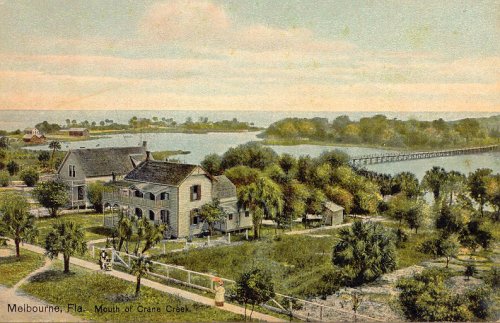
Melbourne, Florida, was founded in 1878 when a transplanted English-Australian named Cornthwaite Hector pitched a tent on the south bank of Crane Creek with his wife Sarah Eleanor and his two young children. The settlement got a post office in 1880, a town plat in 1883, and a charter of incorporation from the Florida legislature on August 6, 1888. That’s the spine. Everything else is who, why, and what they were doing on a tidal creek twelve miles south of the nearest white settlement.
The first thing to clear up is the name. Melbourne is not named for an English aristocrat or a colonial governor. It’s named for Melbourne, Australia, by way of Cornthwaite Hector himself, who had lived in the Victorian capital for sixteen years before moving to Florida. That’s per the City of Melbourne’s own history page and corroborated in the 1987 NRHP nomination for the Old Melbourne Historic District. The Hector family had moved from England to Australia in the 1850s, made a comfortable living, and then come to the United States in the 1870s with enough capital to homestead on a stretch of east Florida nobody else wanted.
Why Crane Creek and not somewhere else
Crane Creek is a short tidal estuary, less than a mile from its headwaters near present-day Hickory Street to its mouth at the Indian River Lagoon. In 1878 it had three things going for it that nothing else in the area did.
First, deep enough water for shallow-draft boats. The Indian River Lagoon was the highway. Until the Florida East Coast Railway reached Melbourne in 1893, you got here by boat or you didn’t get here at all. Crane Creek was the only creek mouth between the Eau Gallie River and the St. Sebastian capable of holding a working sailboat at low tide.
Second, fresh water. The headwaters of Crane Creek tap an artesian aquifer. The Indian River itself is brackish to fully saline depending on rainfall, so a homestead on its banks meant either hauling drinking water from elsewhere or sinking an expensive well. The creek solved that.
Third, a fishery and a citrus latitude that both worked. Mullet, sea trout, redfish, sheepshead, and stone crab were all abundant. The latitude (28°5’ N) was south enough to grow oranges without losing a grove every three winters to frost, and north enough that the summer rainy season hadn’t yet been mapped as the malaria hellscape it would become in tighter Caribbean latitudes.
Hector’s tent went up where the modern Civic Center now stands. Within a year he’d built a frame house and opened a trading post. Within three years there were ten families. Within five there was a school.
The 1880 post office and the name
The federal post office at Melbourne opened July 5, 1880, with Cornthwaite Hector as the first postmaster. Postal records held by the National Archives list the office under the name “Melbourne” from day one. There was a brief argument among the settlers about whether to call the place Crane Creek or Indian River, but Hector’s tenure as postmaster meant his preference won by default. He picked Melbourne because that’s where he’d raised his older children and where his eldest son, Robert, was still living.
The post office is a useful pinpoint because it’s the first federal record of the settlement. Earlier dates (1877 tent landings, etc.) come from family papers and reminiscence, not contemporaneous documents.
The Black settlers
It’s worth being precise here. The earliest census records show Melbourne with both white and Black households from the start. A small community of African American settlers, free or freedmen, were among the founding families. Wright Brothers, Peter Wright, and Balaam Allen are three names that appear in the 1885 Florida state census living within the Melbourne settlement boundary. They worked the citrus groves, the fishing fleet, and the small construction trades. The Booker T. Washington area, which became the historic Black neighborhood west of the FEC tracks, dates to the 1890s but the original Black presence in Melbourne is contemporaneous with the white founding.
The 1883 plat and what it tells us
The first formal plat of Melbourne was filed with the Brevard County Clerk in 1883. It shows a four-block grid bounded by what’s now New Haven Avenue on the north, the Indian River on the east, and Hibiscus Boulevard on the west. The blocks were 300 feet square. Lots were 50 by 150 feet. Hector reserved the riverfront blocks for himself and his immediate family and put the rest on the market at $50 a lot.
That’s a useful number. $50 in 1883 is roughly $1,500 in 2026 dollars. Cheap, but not free. The pricing tells you Hector wasn’t running a charity. He was running a town and he needed solvent buyers.
The plat also reserved a parcel for a school and a parcel for a church. Both were built within two years. The school opened in 1885 in a one-room frame building on what’s now Hibiscus Boulevard. The First Methodist Church organized in 1884 and met in private homes until 1887, when it raised a building.
The 1888 incorporation
Florida’s incorporation law in the 1880s required at least 25 registered voters in a contiguous settlement and a vote of those voters. Melbourne hit the threshold in 1887. The legislature passed a special act of incorporation on August 6, 1888, signed by Governor Edward Aylsworth Perry. The original charter set the city limits at one square mile centered on the post office and provided for a mayor, a five-member council, a marshal, and a clerk.
The first mayor was John C. Stewart, a citrus grower who had settled in 1881. Stewart served two one-year terms. Hector himself declined to run; he was sixty by then and content to keep the post office and the trading post going.
What happens next
The 1888 incorporation didn’t change much in daily life. Melbourne was still a settlement of fewer than 200 people. But the charter mattered because it created a legal entity that could borrow money, levy taxes, and hold property. Within five years of incorporation, Melbourne had voted bonds for a public dock at Crane Creek, paid for a wood-plank sidewalk on the main street, and chartered a fire company. By 1893 the FEC arrived and the place was on the map nationally.
The point of the founding decade, 1878 to 1888, is that everything that mattered about Melbourne later was already in place by the time the city had a charter. The creek. The lagoon. The citrus. The mixed white and Black population. The Australian-via-England founder. The civic-mindedness that would later get the Henegar School built (1919), the Melbourne Public Library funded (1925), and the FIT charter granted (1958).
Hector died in 1898 at age seventy. He’s buried in Melbourne Cemetery, a few blocks west of the creek he picked.
Sources
- City of Melbourne, “About Melbourne / Our History,” accessed 2026-01-04. https://www.melbourneflorida.org/about-us/about-melbourne/our-history
- US National Register of Historic Places nomination, “Old Melbourne Historic District,” NRIS 87000926, accessed 2026-01-04. https://npgallery.nps.gov/AssetDetail/NRIS/87000926
- Florida Memory Project, State Archives of Florida, Melbourne and Brevard photographs and documents, accessed 2026-01-04. https://www.floridamemory.com/
- USPS Postmaster Finder, Melbourne FL office history, accessed 2026-01-04. https://about.usps.com/who/profile/history/post-office-finder.htm
- 1885 Florida State Census, Brevard County returns. State Library and Archives of Florida.
- Florida Special Acts of 1888, Chapter 3856, “An act to incorporate the town of Melbourne in the county of Brevard.”
Further Reading
As an Amazon Associate we earn from qualifying purchases.