Melbourne's Booker T. Washington community
The historic Black neighborhood west of the FEC tracks, organized around the Booker T. Washington School and a network of Black businesses and churches that operated under segregation from the 1890s through the 1960s.
Melbourne had a Black community from the founding. The 1885 Florida state census listed several Black households among the early settlers (Wright Brothers, Peter Wright, and Balaam Allen are three names from contemporary records). By the 1890s, segregation had crystallized that informal community into a defined geographic neighborhood west of the Florida East Coast Railway tracks, centered on the Booker T. Washington School at what would become the area of West New Haven Avenue and South Washington Avenue. The Booker T. community operated as a parallel city through the segregation era, with its own businesses, churches, social institutions, and schools. The 1960s desegregation officially ended the separation but the neighborhood’s historical organization persisted, and many institutional remnants survive.
This article works from primary sources where available. The historiography of Black communities in small Florida towns is thinner than for white settler communities of the same period; many primary records are uneven or weren’t preserved. We’ve drawn on Florida Memory’s African American collections, FAMU’s archival holdings on Brevard, and Brevard Public Schools’ historical files.
The earliest Black settlers, 1880s
Black settlement in Melbourne was contemporaneous with the white founding, not later. The 1885 Florida state census recorded several Black households living within the Melbourne settlement boundary. These were free Black families, not enslaved, since slavery had been abolished twenty years earlier. The settlers worked in:
- Citrus groves: as workers in the early growth phase, sometimes as small-acreage independent growers.
- The fishing fleet: as crewmen, fish-house workers, and sometimes as boat owners.
- Construction: carpentry, painting, and general building.
- Domestic service: for the wealthier white families.
The Wright Brothers, Peter Wright, and Balaam Allen names appear in multiple early records. The Wright family in particular owned land and operated a small business in the 1890s. They were among Brevard County’s earlier Black property owners.
Segregation and the geographic concentration
The post-Reconstruction segregation regime that hardened across the South after 1877 affected Melbourne directly. Florida’s Constitution of 1885 mandated segregated schools and discouraged integrated public accommodations. Federal recognition of state segregation authority (formalized in Plessy v. Ferguson, 1896) cemented the pattern legally. Through the 1890s and 1900s, informal patterns of where Black families could buy property hardened into formal patterns of where they could live.
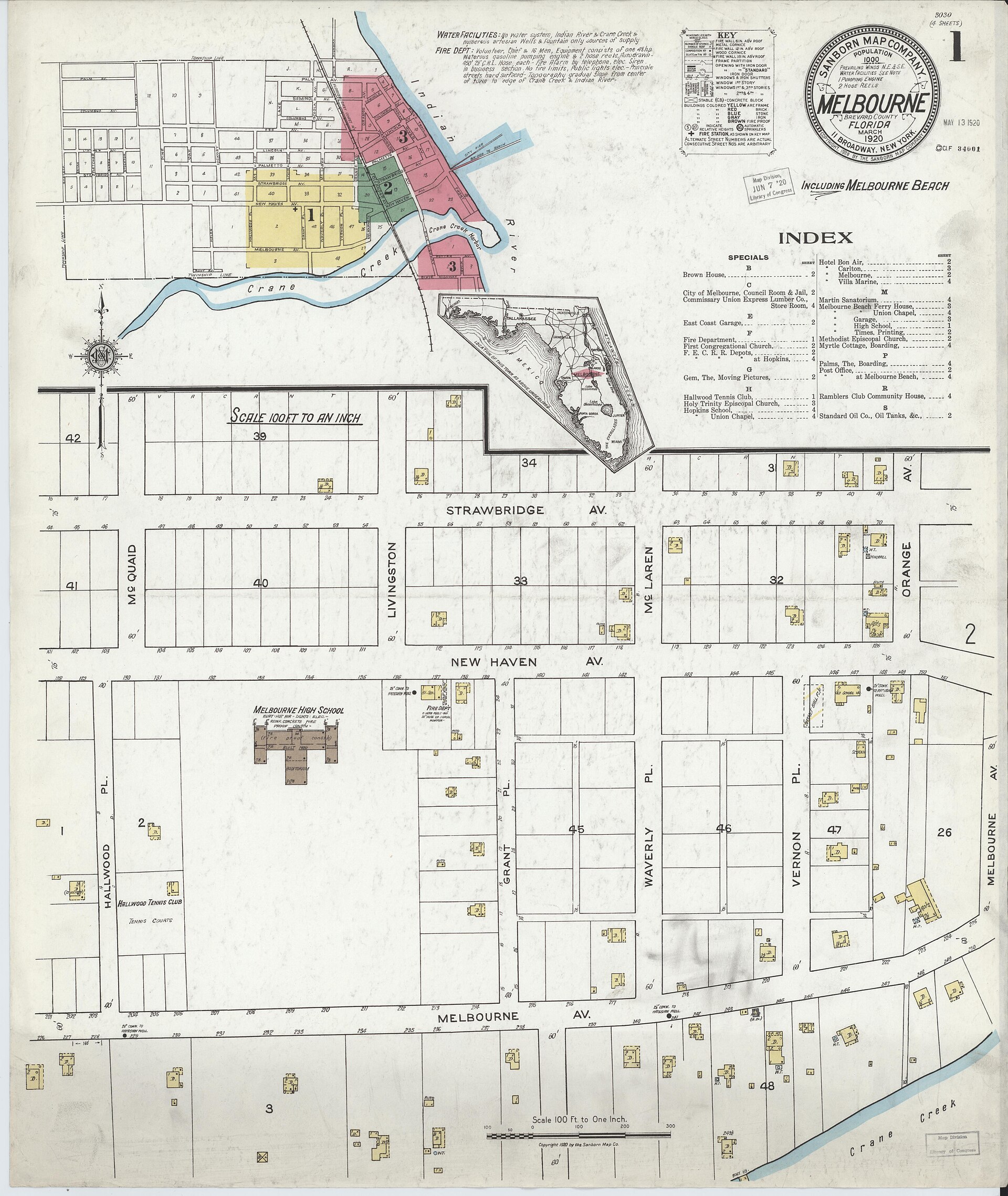
In Melbourne, the FEC railroad tracks running north-south through the city became the de facto color line. Black settlement concentrated west of the tracks. The white commercial core was east of the tracks (along New Haven Avenue and Front Street). The two communities were physically separate, divided by a railroad embankment that was difficult to cross safely on foot.
By 1910 the Black neighborhood west of the tracks had:
- Several blocks of Black-owned homes, mostly small frame houses.
- The Booker T. Washington School, the segregated public school for Black children.
- Several Black churches, including a Methodist and a Baptist church.
- Black-owned small businesses: a grocery, a barbershop, a few restaurants, a small lodge hall.
The Booker T. Washington School
The Booker T. Washington School was Melbourne’s segregated public school for Black students from the early 1900s through 1969, when desegregation under federal court order finally took effect. The school’s history mirrors what happened to similar schools across the South.
The first building was a small frame structure on Washington Avenue (a name that predates the school but became associated with the institution). Through the 1920s and 1930s a larger building replaced the original. The school taught Black students from elementary through high-school grades, with separate facilities for younger and older students.
The Booker T. faculty was Black, often educated at Florida A&M University or other historically Black colleges. Pay was substantially lower than for white teachers in Melbourne’s segregated white schools. Facilities were demonstrably inferior: smaller libraries, less science equipment, fewer textbooks (often hand-me-down materials from the white schools), inferior building maintenance. The disparity was deliberate and consistent throughout the segregation era.
Despite the disadvantages, the Booker T. School produced graduates who went on to FAMU, to military service, to successful careers in education, ministry, and business. The institutional memory of the school remains strong in Brevard’s older Black community.
Daily life under segregation
The Booker T. community operated as a parallel city. A typical day for a Black resident might involve:
- Working in citrus, fishing, construction, or domestic service for white employers.
- Shopping at Black-owned businesses in the West Melbourne neighborhood plus a few Black-accommodating sections of the white-served commercial core.
- Attending a Black church on Sunday.
- Sending children to the Booker T. School.
- Socializing in Black-only spaces (the lodge halls, the church, private homes).
Some commercial transactions crossed the racial boundary: Black customers patronized certain white-owned hardware stores, drugstores, and grocers. The cross-boundary trade was typically conducted with awkward formal protocols: Black customers might be served at separate counters or windows, might be expected to enter through different doors, might be expected to defer in line.
Public accommodations were segregated. The FEC depot had separate waiting rooms. The Strand Theatre had a separate balcony section for Black patrons. Restaurants were either Black-only or white-only. Hotels did not accommodate Black guests at all (Melbourne’s small hotel industry served the white winter colony exclusively).
Public services were unequal. The Black neighborhood had inferior streets, drainage, lighting, and sanitation. Police service in the Black community was minimal for ordinary protection but harsh for enforcement.
The 1960s and desegregation
Federal civil rights legislation in 1964 and 1965 began the formal end of segregation. School desegregation followed through court orders. The Brevard County school system, which had been consolidated at the county level in 1960 but remained internally segregated, came under federal court orders to desegregate in the late 1960s. Full desegregation of Brevard schools was achieved by 1969.
The Booker T. Washington School ceased operation as a segregated Black school in 1969. The building was repurposed under the consolidated Brevard County district. The Booker T. faculty, in many cases, were transferred to other Brevard schools. Some of the senior Booker T. teachers continued in administrative or specialty teaching roles in the desegregated district through the 1970s and 1980s.
Desegregation didn’t immediately or fully end residential or commercial segregation. The Black neighborhood west of the FEC tracks remained substantially Black-populated through the 1970s and 1980s, though restrictive covenants had been formally eliminated and Black families could now buy property elsewhere. Many chose to remain in the historic neighborhood for community, family, and church connections.
What survives
Several elements of the Booker T. community persist:
The neighborhood: West Melbourne, around West New Haven Avenue and the surrounding blocks, remains a historically Black-majority area with a distinct identity within the city.
Several churches: Multiple historic Black churches continue to operate in the neighborhood, several with founding dates in the early 1900s or earlier.
Institutional memory: An older generation of Brevard residents lived through the segregation era and remembers the institutions directly. Oral history projects have captured some of this memory; more should be done while the memory remains accessible.
Some buildings: A few historic structures from the Black-owned business district survive, with varying preservation status.
The Booker T. Washington name: The school is gone, but the name persists in several Brevard institutions and in the cultural identity of the neighborhood.
What’s been lost or under-documented
The historiography of Melbourne’s Black community is thinner than it should be. Records of Black-owned businesses, Black homes, Black social organizations are scattered and incomplete. Many of the original buildings of the Booker T. era have been demolished or substantially altered.
The Florida Memory archives and FAMU’s archival holdings have some materials but the systematic documentation that’s been done for white settler families isn’t matched for the Black community. This is a recurring pattern across small Florida towns and a gap that deserves more attention.
For Melbourne specifically: the Booker T. Washington School deserves a substantial institutional history. The Black-owned businesses of the 1900-1960 period deserve documentation. The families who lived through segregation in Melbourne deserve oral histories before the last generation that remembers directly passes away.
Some of this work has begun. Florida Memory’s oral history project has captured a number of Brevard interviews. The Brevard Cultural Alliance and the FAMU archives have ongoing documentation efforts. More should be done, and faster.
Sources
- Florida Memory Project, African American Brevard County collections and oral histories, accessed 2026-01-27. https://www.floridamemory.com/
- Florida A&M University archives, Brevard County records and Booker T. Washington School documentation, accessed 2026-01-27. https://www.famu.edu/
- Brevard Public Schools, historical records on the Booker T. Washington School and desegregation, accessed 2026-01-27. https://www.brevardschools.org/
- US Census Bureau, decennial population counts for Melbourne FL with racial composition, 1900 through 1970.
- 1885 Florida state census, Brevard County returns. State Library and Archives of Florida.
- Florida Constitution of 1885, segregation provisions.
- Federal court orders, Brevard County school desegregation proceedings, late 1960s.
Further Reading
As an Amazon Associate we earn from qualifying purchases.